Wednesday, February 28, 2007

A Copernican Revolution (Part Two)

As one moves from Dispensationalism to a Reformed understanding of the Scriptures, one must undergo a paradigm shift. I have compared this to the Copernican revolution, going from a geo-centric view of the universe to a helio-centric view.

Both systems have the same data; they both claim to be basing their theology on the exegesis of the Scriptures. However, there are underlying presuppositions that govern the conclusions that one comes to.

One of the key presuppositions on both sides is that of continuity or discontinuity between the Old and New Testaments. Dispensationalists presume discontinuity; whereas Reformed Theologians presume continuity.

For example, when it comes to the relationship between Israel and the Church, Dispensationalists presume discontinuity. The argument goes like this: “The Bible never says that the church is Israel; therefore they are different entities with different purposes and different destinies.”

The Reformed Theologian says, “The Bible never says that the church is not Israel, therefore they are the same.”

The Bible neither explicitly affirms or denies that the church is Israel. The difference is that each side assumes contrary positions.

When the Dispensationalist encounters Scriptures that seem to favor continuity, he falls back upon the lack of a plain statement from Scriptures. Therefore, we should presume discontinuity.

When the Reformed Theologian encounters Scriptures that seem to favor discontinuity, he falls back upon the lack of a plain statement from Scriptures. Therefore, we should presume continuity.

The question we must ask is: which presupposition is most consistent with the Scriptures.?

I started out by presuming discontinuity. As I studied the Scriptures, I kept running up against verses that seemed to teach continuity (e.g., Genesis 12, 15, 17; Galatians 3, 4; Ephesians 2-3; Hebrews 8-10). At first, I was able to explain these away, but I would only encounter more continuity verses. It seemed that continuity was jumping out at me from every page of Scripture.

Finally, I had this radical thought: what if I presumed continuity? I tried this out and found it to be a much more satisfactory explanation of the Scriptures. At every turn, I found that continuity fit much more solidly with the Scriptures. I felt like Copernicus when he found that presuming helio-centrism matched the evidence much more closely than geo-centrism.

Monday, January 29, 2007

A Copernican Revolution (Part One)

Leaving Dispensationalism behind was a long process for me. It was not something that happened overnight, nor was it just a matter of tweaking a few theological points. Moving from Dispensationalism to Reformed Theology involved an entire paradigm shift. I have often compared this shift to what it must have been like for Copernicus to change from a geo-centric view of our solar system to a helio-centric view.

Before Copernicus, geo-centrism was the dominant perspective. It seemed to make sense. However, as Copernicus did his calculations, something didn’t add up. He saw the same sun, planets, and stars as the previous astronomers, but he discovered that if the earth was truly the center of our solar system, then the planets should behave differently than they do. The conclusion is that there must be a different center. Copernicus suspected that the sun was the center of our solar system, and his calculations confirmed this. Today, Copernicus is credited with changing astronomy from geo-centrism to helio-centrism, and we call this the Copernican revolution.

I had my own Copernican revolution in my theological journey. When I was first exposed to Dispensational ideas, I would go back to the Scriptures to see if these things were so. A lot of things made sense.

However, as I got deeper into Dispensationalism, I began to notice a verse here and there that did not seem to fit in the Dispensational scheme. This troubled me, so I asked my pastor, but he did not have a satisfactory answer. I thought that seminary would explain things better.

Unfortunately, when I got to seminary, the problems compounded. I was finding entire passages that seemed to conflict with Dispensationalism, both OT and NT. It seemed like everywhere I turned, there was a problem passage. I began to suspect that the problem was not with the Scriptures but with Dispensationalism itself. I was reading the same Bible as the Dispensationalists, but the Scriptures behaved in patterns that defied Dispensationalism.

I thought, what if there is another theological system that made better sense out of the Scriptures? As I investigated Reformed Theology, I found that it comported much better with the Bible. The old problem passages now made perfect sense. Thus, my move to Reformed Theology did not involve a rejection of the Bible, but embracing an alternative explanation for the Bible. Much like Copernicus, I was using the same data as my Dispensational friends, but the data forced me to come to a different conclusion. I'll cover some specific examples next.

Monday, January 22, 2007

Spellbound by the Reformers?

When I ran in Dispensational circles, I was frequently told that those who left Dispensationalism for Reformed Theology did so because they were spellbound by the Reformers. Perhaps you’ve heard something like this:

“People become Reformed because they love Calvin and the Puritans. They have so much respect for these men that they swallow their theology whole. Reformed Theology is uncritically accepted.”

For me, this was certainly not the case. I became Reformed because of the Scriptures. My journey was a thoroughly exegetical one. While in seminary, I read through the entire Bible multiple times. I read selected chapters hundreds of times. I memorized dozens of relevant passages. I studied the Greek and the Hebrew in countless texts. In short, I became Reformed because I was convinced that this is what the Bible taught.

Of course, I came to appreciate the Reformers and the Puritans. I read a few contemporary Reformed books (R.C. Sproul, namely), but I never took anyone’s word for it. I always went back to the Scriptures to check and see if these things were so. This is what dispensationalists had taught me to do.

Furthermore, I have many friends and acquaintances who moved from Dispensationalism to Reformed Theology. None of them embraced Reformed Theology because of being spellbound by the Reformers and Puritans.

I’m not sure how this myth got started, but I suspect that it is often recycled because Dispensationalists cannot fathom that the Bible might teach something different. There must be some other explanation. So, who’s the one that is spellbound?

Friday, January 19, 2007

Leaving Dispensationalism Behind (Part Five)


In the middle of my fourth year in seminary, I embraced paedobaptism. This was the biggest hurdle because infant baptism is frequently portrayed as a Roman Catholic holdover from the Reformation. I fought this move harder than any other. I scoured both the library and internet for arguments for and against paedobaptism. However, the Biblical evidence began to be so overwhelming that I could see the writing on the wall. Intellectually, I was paedo for months before I could embrace it emotionally. This was a scary move because I knew that none of my classmates or professors would understand. Nevertheless, I had to follow the Scriptures at whatever “peril” to myself.

We eventually settled into the same church (PCA) that Big Red had joined. For all my fretting, joining a reformed church was a huge relief. I found instant camaraderie with a slew of former Baptists. The pastor was very generous with his time, and I was given numerous teaching opportunities. I developed some good friendships with many of the men in the church. At one time, the three interns at our church were myself, the Boneman, and the Craw. Quite a triumvirate! Those were the days.

I thought about transferring to a reformed seminary, but that would have set me back three years. I was ready to graduate and start to pastor, so I decided to remain at Master’s, and looking back, that was the best decision. I finished up my last three semesters and graduated in May 2004.

In January 2005, we moved back to Kansas City to pastor Christ Covenant Presbyterian Church (PCA). We have been there two years now, and it has been a constant blessing to us.

There are many more autobiographical details that I hope to share later, but I wanted to provide an overview of my journey. Hopefully, this will resonate with those who are thinking about leaving dispensationalism behind. Pax.

Wednesday, November 01, 2006

Leaving Dispensationalism Behind (Part Four)


During my third year in seminary, I could no longer accept the dispensational distinction between Israel and the church. I saw much more continuity than discontinuity in the Bible. I was no longer a dispensationalist, yet I was not comfortable with full-blown covenant theology. What was I?

Some of the resources that helped me see more continuity between Israel and the church were from the perspective known as New Covenant Theology (NCT). I liked this group because they seemed to be a middle ground between Dispensational Theology (DT) and Covenant Theology (CT), which is where I found myself. They also seemed to be charitable in their relations with the other options. This was a huge plus for me because I was tired of hearing both DT and CT blast each other.

I joined an NCT email discussion group and enjoyed reading the email volleys. I was being sharpened, but I kept running into problems understanding their peculiar view of the law, among other things. Over time, I came to see that NCT is not really a middle position. It is just one step past Progressive Dispensationalism, making NCT far closer to DT than CT.

Near the end of my NCT days, the whole Baptism puzzle fell into place. Some NCTers were urging that because the children of believers are unbelievers, they should be treated as such. For instance, since God does not hear the prayers of an unbeliever, we should not teach our children to pray until they are converted. Furthermore, we should not permit our children to sing to the Lord because until they are converted, all of their singing is “strange fire.” I was horrified at such arguments, yet this is the logical conclusion of the Baptist position. NCTers are the only ones who pressed it this far. However, this seemed to conflict with all of the parental instruction from Scripture. “There has to be a better way,” I thought. And I discovered that there is: paedobaptism!

Wednesday, October 25, 2006

Leaving Dispensationalism Behind (Part Three)


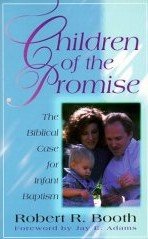
At the end of my first year in seminary, Big Red and his family moved into our apartment complex, which allowed us to continue our theological conversations on a much more regular basis. During one of our talks, I spied a book on Red’s desk called Children of the Promise by Randy Booth. To my shock and horror, the subtitle was The Biblical Case for Infant Baptism. What an oxymoron! I knew that there was absolutely no Biblical evidence for baptizing infants. This was a tradition left over from Rome.

I made no mention of this to Red, but I immediately procured the book from The Master’s library. I read it with extreme skepticism. I doubted every assertion and quibbled over every point of his exegesis, but after reading the book, I knew I was in serious trouble. I was far from convinced, but for the first time, I had to acknowledge that there was a legitimate Biblical argument for infant baptism.

I had always approached baptism as an independent issue. Booth’s book helped me understand that baptism is largely determined by the relationship between Israel and the church. Baptism is a symptom of ecclesiology.

For the next couple of years, I wrestled with the issue of Israel and the church. During this time I read through the Bible multiple times, always with an eye towards understanding the relationship between Israel and the church. I paid careful attention to Genesis 12-17, Romans 9-11, Galatians 3-4, Hebrews 8-10, as well as hundreds of other related passages. I began to come to the conclusion that the church is a continuation of what God began with Abraham (and ultimately with Adam).

When I came to reject a hard distinction between Israel and the church, my dispensational house of cards toppled. However, I did not immediately jump to a covenantal view. I made a pit stop in New Covenant Theology, a Reformed Baptist sect of recent origin.

Tuesday, October 24, 2006

Leaving Dispensationalism Behind (Part Two)

We moved to Los Angeles in July of 1999 to attend The Master’s Seminary. During one of our first Sundays at Grace Community Church, we met a young couple who had just moved to California for a new job. We quickly became friends with Big Red and Mrs. Big Red (despite their aberrant collegiate loyalties). We invited them over for dinner, and during the course of the evening, Big Red began to articulate a partial preterist view of prophecy. I was somewhat familiar with amillennialism, but I had never encountered preterism.

I applied the standard dispensational defense and accused Big Red of “spiritualizing” and “allegorizing.” Unfazed, Big Red urged me to apply my “literalism” to the time texts in the Olivet Discourse and the book of Revelation. I couldn’t. I was dumbfounded. And scared. For the next week, I felt like a zombie. I had just moved my family half-way across the country, and I was wondering if I had made a mistake.

I read the Bible voraciously. Time texts seemed to jump off of every page. I could not avoid them or explain them away. I borrowed Big Red’s copy of The Last Days According to Jesus by R.C. Sproul and read it twice. I listened to a set of tapes from a Ligonier conference on eschatology. I was blown away. My dispensational ship had hit an iceberg and began to take on water.

However, I was starting my first semester of seminary, and so, I tried to put preterism and eschatology on the back burner. Without intending to, I wound up writing a couple of seminary papers refuting aspects of preterism, but I always had an uneasy feeling in the back of my mind. The time texts continued to plague me throughout the year, particularly Matthew 24:34,

“Assuredly, I say to you, this generation will by no means pass away till all these things take place.”

As I wrestled with this text and others, I dug my heels in, stubbornly refusing to admit defeat. I scoured the Bible for answers. Big Red patiently endured my feeble objections. By the end of my first year in seminary, I clearly saw the fatal flaw in dispensational eschatology: selective literalism.

However, it would be another two years before I would embrace preterism. In the meantime, a new problem arose. Big Red began talking about the “B” word, and I was appalled.

Monday, October 09, 2006

Leaving Dispensationalism Behind (Part One)


I was introduced to dispensationalism at the age of twelve by the movie, A Thief in the Night. A couple of years later, I was attending a Christian high school basketball game. They were giving hand stamps so that you could enter and leave the facility, but I refused the stamp, thinking it could be the mark of the beast. I was a teenage dispensationalist.

During spring break in my junior year at college, I took a trip to Daytona beach with Campus Crusade for Christ, and heard Ron Ralston give a week’s worth of lectures on the end times from a staunchly dispensational perspective. He was so persuasive that I immediately jumped on board.

After graduating from college, I read Faith Works by John MacArthur, and was intrigued by the appendix on dispensationalism. I loved MacArthur’s commitment to the Bible, and I was hungry to understand the Biblical basis for dispensationalism.

I read Dispensationalism Today by Charles Ryrie. I appreciated his presentation of the sine qua non of dispensationalism, but overall, I was deeply disappointed by the lack of Biblical exegesis and the reliance upon philosophical arguments.

I tried reading Dispensationalism, Israel, and the Church but understood very little. Blaising and Bock’s second book, Progressive Dispensationalism, was more helpful, but I was still lacking a comprehensive dispensational worldview.

About that time, I started attending a Bible church, where dispensationalism was alive and well. For five years, I was taught classic-dispensationalism, which centered on three main points:

1) Literal Interpretation
2) A Distinction between Israel and the Church
3) Pre-Mill Eschatology with a Pre-Trib Rapture

I fully imbibed from the dispensational tap, first with The Ryrie Study Bible and later with The MacArthur Study Bible. I read The Greatness of the Kingdom by Alva J. McClain, Things to Come by Dwight Pentecost, and other similar books. Most importantly, the pastor was very generous with his time, fielding my questions and patiently explaining the finer points of dispensationalism to me.

The first ripple in my dispensational pond started when a friend of mine began to show me some flaws in the classic-dispensational view of the kingdom, particularly that Israel did not reject Christ’s “offer” of the Millennial Kingdom in his first advent. I re-read the two Blaising and Bock books with a much greater appreciation. I agreed with their critique of classic-dispensationalism, particularly with regard to the present nature of kingdom. This was confirmed as I taught through the Lord’s Prayer.

So, I migrated to a progressive-dispensational understanding of the Bible. No problem, I thought. I’m still a dispensationalist. I still believe in a literal hermeneutic, a distinction between Israel and the Church, and a pre-trib rapture.

However, I hit another speed bump during a Wednesday night series on eschatology, when I was asked to teach on the difference between the rapture and the second coming. As I diligently studied for this, I was alarmed at the paucity of Biblical evidence for such a distinction. I concluded that I must to do a full-scale study of eschatology at some point.

About this time, I decided to attend The Master’s Seminary in Los Angeles, California. I longed for the opportunity to study the Bible in detail and polish my theological views. I had no idea that within a month of moving to LA, my dispensational ship would hit an iceberg and began to take on water.

Welcome!


I started this blog because I hope 1) to assist those who have questions about dispensationalism and 2) to challenge those who are committed to dispensationalism to reconsider the Biblical evidence. I am committed to keeping the tone irenic and charitable. I have no desire to host a SMOG (Slinging Mud On Blog).

I am qualified to provide an even-handed critique, as I was immersed in dispensationalism for ten years. I was part of a dispensational church for five years, and then, I spent five years at The Master’s Seminary, one of the top dispensational schools in the world. I graduated summa cum laude in May 2004 with a Master of Divinity. I am now the pastor of Christ Covenant Presbyterian Church (PCA) in Kansas City, Missouri.

Most of my posts will be in one of these three categories that are unique to dispensationalism:

• Hermeneutics – literal interpretation, metaphor, typology, etc.
• Ecclesiology – Israel, the Church, dispensations, covenants, etc.
• Eschatology – end times, the rapture, pre-trib, pre-mill, etc.

My first few posts will be autobiographical sketches of my journey into and out of dispensationalism. These are not intended to be full-scale critiques with proof texts. That will come later. Pax.