Thursday, July 19, 2007

Jesus and the Nation of Israel

Last week we looked at the controversial issue of whether the NT Church is the continuation of OT Israel. The central issue here is determining who the descendents of Abraham are.

Discontinuity Theologians argue that the descendents of Abraham are his physical offspring, those who are related to Abraham by blood. Because the promises are made to Abraham’s physical children, only Jews can inherit the promises to Abraham. Therefore, the church cannot inherit the promises to Abraham.

Continuity Theologians argue that the descendents of Abraham are his spiritual offspring, those who are related to Abraham by faith. Because the promises are made to Abraham’s spiritual children, ethnicity is not the determinative factor. Therefore, the church can inherit the promises to Abraham.

Obviously, the people to whom God makes promises must be the people who receive the fulfillment of the promises. The Israel of promise must be the Israel of fulfillment. Who is Israel?

Israel/Jew as Ethnic Terms
There are times when the Bible speaks of Israel in terms of ethnicity, or physical descent from Abraham.

Roma 9:3 (NKJV) For I could wish that I myself were accursed from Christ for my brethren, my countrymen according to the flesh,
4 who are Israelites, to whom pertain the adoption, the glory, the covenants, the giving of the law, the service of God, and the promises;
5 of whom are the fathers and from whom, according to the flesh, Christ came, who is over all, the eternally blessed God. Amen.

Paul speaks of the profound advantage that ethnic Jews had over Gentiles.

Roma 3:1 (NKJV) What advantage then has the Jew, or what is the profit of circumcision?
2 Much in every way! Chiefly because to them were committed the oracles of God.

The Bible uses does sometimes use “Israel” and “Jew” to refer to ethnic descendents from Abraham, regardless of their faith.

This is how most of the world uses these terms today. “Israel” is usually a reference to the modern nation of Israel, which is comprised of ethnic descendents from Abraham. We call them Jews. These are ethnic designations. They have little or nothing to do with religion. An atheist Jew is still considered a Jew.

Only 15% of the modern nation of Israel are practicing Judaism. Even fewer are Orthodox Jews. Yet, we continue to call them “Jews” and “Israel.” This is fine, as long as we understand this as a strictly ethnic designation. We need to acknowledge that the Bible does sometimes speak of Israel/Jews in an ethnic sense.

Israel/Jew as Spiritual Terms
What we need to remember is that ethnic descent from Abraham has never been a qualification for inheriting the promises to Abraham.

Genesis and the OT
Last week, we looked at Genesis 12-17 and how not all of Abraham’s natural offspring will inherit the promises. For example, Ishmael and his descendents are not part of the covenant. Abraham’s six sons by Keturah are not included. The line of Esau is cut off. When God establishes circumcision in Genesis 17, he states that those who are not circumcised are cut off. So, not all of Abraham’s ethnic descendents inherit the promises.

We also saw how God expands the line of promise beyond physical descendents. Foreigners became heirs to the promises through circumcision. Converts such as Rahab and Ruth not only became Jews but married into the line of David and of Christ.

Romans 2
The NT makes it even more explicit. Paul explains that a true Jew does not depend on ethnicity, but on an internal work of the heart.

Roma 3:1 (NKJV) What advantage then has the Jew, or what is the profit of circumcision?
2 Much in every way! Chiefly because to them were committed the oracles of God.

Paul is saying in 3:1-2 that ethnic Jews have an advantage over Gentiles because ethnic Jews were in covenant with God, they were entrusted with the law of God, etc.

Nevertheless, Paul has already made it clear that this advantage is wasted if it is not combined with faith. In 2:28-29, Paul specifically states that spiritual Jews are true Jews.

Roma 2:28 (NKJV) For he is not a Jew who is one outwardly, nor is circumcision that which is outward in the flesh;
29 but he is a Jew who is one inwardly; and circumcision is that of the heart, in the Spirit, not in the letter; whose praise is not from men but from God.

Romans 9
In Romans 9:3-5, Paul laments that ethnic Israel does not believe in Jesus as Messiah.

Roma 9:1 (NKJV) I tell the truth in Christ, I am not lying, my conscience also bearing me witness in the Holy Spirit,
2 that I have great sorrow and continual grief in my heart.
3 For I could wish that I myself were accursed from Christ for my brethren, my countrymen according to the flesh,
4 who are Israelites, to whom pertain the adoption, the glory, the covenants, the giving of the law, the service of God, and the promises;
5 of whom are the fathers and from whom, according to the flesh, Christ came, who is over all, the eternally blessed God. Amen.

Paul rehearses the advantages that ethnic Israelites have. Yet, Paul also teaches that not all of ethnic Israel will be saved.

Roma 9:6 (NKJV) But it is not that the word of God has taken no effect. For they are not all Israel who are of Israel,
There is an Israel (ethnically) that is not Israel (spiritually). Whenever those who claimed to be Israel assumed that Israel was a fixed and static entity, a people self-evident to all, the prophets issued strong warnings.

The promises given to Israel were not like automatic guarantees to be received apart from faith and obedience. Because Israel was disobedient, the prophets announced that in the end, only a remnant would be saved.

Isai 10:20 (NKJV) And it shall come to pass in that day
That the remnant of Israel,
And such as have escaped of the house of Jacob,
Will never again depend on him who defeated them,
But will depend on Yahweh, the Holy One of Israel, in truth.
21 The remnant will return, the remnant of Jacob,
To the Mighty God.
22 For though your people, O Israel, be as the sand of the sea,
A remnant of them will return;
The destruction decreed shall overflow with righteousness.

The vast majority of ethnic Israel was faithless. This is why Jesus said that claiming ethnic descent from Abraham was never a sufficient basis for claiming the covenant promises.

Matt 3:9 (NKJV) “and do not think to say to yourselves, ‘We have Abraham as our father.’ For I say to you that God is able to raise up children to Abraham from these stones.

Jesus is using “children of Abraham” in a spiritual sense. This was God’s desire all along, that ethnic Israel would also be believing Israel.

Galatians 3
In Galatians 3, Paul explains that Abraham’s sons are those who have faith.

Gala 3:7 (NKJV) Therefore know that only those who are of faith are sons of Abraham.

Furthermore, Paul states that the true descendent of Abraham is Jesus Christ.

Gala 3:16 (NKJV) Now to Abraham and his Seed were the promises made. He does not say, “And to seeds,” as of many, but as of one, “And to your Seed,” who is Christ.

Thus, what is important is not physical descent from Abraham. What is important is spiritual descent from Abraham and ultimately, Abraham’s seed, Jesus Christ.

Gala 3:29 (NKJV) And if you are Christ’s, then you are Abraham’s seed, and heirs according to the promise.

Gentiles who have no physical relationship with Abraham can become a descendent of Abraham and heirs of the promise if they are spiritually related to Jesus Christ.

From Israel to the Nations
God’s promises to Abraham were always intended to expand beyond his ethnic descendents.

Gene 12:1 (NKJV) Now Yahweh had said to Abram:
“Get out of your country,
From your family
And from your father’s house,
To a land that I will show you.
2 I will make you a great nation;
I will bless you
And make your name great;
And you shall be a blessing.
3 I will bless those who bless you,
And I will curse him who curses you;
And in you all the families of the earth shall be blessed.”

God later reiterated this promise.

Gene 22:18 (NKJV) “In your seed all the nations of the earth shall be blessed, because you have obeyed My voice.”

The blessing of the nations was going to come from the descendents of Abraham.

Isaiah
Isaiah prophesied of the blessing being given not just to Israel, but to the other nations as well.

Isai 19:23 (NKJV) In that day there will be a highway from Egypt to Assyria, and the Assyrian will come into Egypt and the Egyptian into Assyria, and the Egyptians will serve with the Assyrians.
24 In that day Israel will be one of three with Egypt and Assyria-- a blessing in the midst of the land,
25 whom Yahweh of hosts shall bless, saying, “Blessed is Egypt My people, and Assyria the work of My hands, and Israel My inheritance.”

Egypt will be called “My people.” Assyria will be called “the work of My hands.” These are prophesies of the expansion of the blessing from Israel to all the world.

Israel was to be a light to the nations.

Isai 42:6 (NKJV) "I, Yahweh, have called You in righteousness,
And will hold Your hand;
I will keep You and give You as a covenant to the people,
As a light to the Gentiles,
7 To open blind eyes,
To bring out prisoners from the prison,
Those who sit in darkness from the prison house.

God did not elect Israel to be his only people on the earth. He elected them to reach all the peoples on the earth.

Jesus
Jesus was blunt with Israel in his day.

Matt 8:11 (NKJV) “And I say to you that many will come from east and west, and sit down with Abraham, Isaac, and Jacob in the kingdom of heaven.
12 “But the sons of the kingdom will be cast out into outer darkness. There will be weeping and gnashing of teeth.”

Just before his ascension, Jesus commands the gospel be taken to the world.

Matt 28:18 (NKJV) And Jesus came and spoke to them, saying, “All authority has been given to Me in heaven and on earth.
19 “Go therefore and make disciples of all the nations, baptizing them in the name of the Father and of the Son and of the Holy Spirit,

Through Jesus, the Son of Abraham, all nations are being blessed and the promise to Abraham is being fulfilled.

This fulfills the reason that the Father sent Jesus.

John 3:16 (NKJV) "For God so loved the world that He gave His only begotten Son, that whoever believes in Him should not perish but have everlasting life.

This is celebrated in heaven.

Reve 5:9 (NKJV) And they sang a new song, saying:
"You are worthy to take the scroll,
And to open its seals;
For You were slain,
And have redeemed us to God by Your blood
Out of every tribe and tongue and people and nation,

Thus, God’s plan was never to limit the blessing of his promises to the ethnic descendents of Abraham. God’s plan was to use the ethnic descendents to bless the entire world.

Ethnic Israel largely failed at this task. It was not until God sent Jesus as the true Israel that the nations were brought to God.

Thursday, July 12, 2007

Is the Church Israel?

Continuity vs. Discontinuity
In the past two sessions, we have looked at the relationship between the Old Testament and the New Testament. There are two general approaches to understanding this complex relationship:

· Continuity – there is a basic unity between the OT and the NT. The NT continues what the OT began.

· Discontinuity – there is a basic distinction between the OT and the NT. The NT begins a new project that is not a continuation of the OT.

Important Disclaimer
No one argues for strict continuity or strict discontinuity. That is, everyone believes in some continuity (e.g., we believe in one God) and some discontinuity (e.g., we no longer offer animal sacrifices). The difficulty is determining how much stays the same (continuity) and how much is different (discontinuity).

Rightly Dividing?
In discussing continuity and discontinuity between the Old and New Testaments, many who argue for discontinuity appeal to 2 Timothy 2:15:

2Tim 2:15 (NKJV) Be diligent to present yourself approved to God, a worker who does not need to be ashamed, rightly dividing the word of truth.

According to this view, “rightly dividing the word of truth” means that the task of the interpreter is to distinguish OT truth from NT truth.

However, “rightly dividing” is an archaic expression that actually means “handling accurately” or “using correctly.” The NASB renders this in contemporary language.

2Tim 2:15 (NASB) Be diligent to present yourself approved to God as a workman who does not need to be ashamed, handling accurately the word of truth.

Was Israel a Church?
Last week, we considered the question, “Was Israel a church?” This question is somewhat complicated by a translation problem. The word that is most often translated as “church” is the Greek word, ekklesia. Yet, “church” and ekklesia are actually completely different words. So, this question “Was Israel a church?” needs to be answered in two parts:

Was Israel the Ekklesia?
Ekklesia simply means a group of people, a congregation of people, an assembly of people, a gathering of people. It refers to some kind of corporate group of people. This is not an exclusively religious word, as it was commonly used in the secular sense of referring to civil assemblies.

If we take the literal meaning of ekklesia, was Israel the ekklesia? Absolutely! Israel was a group of people.

Moreover, this is supported by the Greek version of the OT, the Septuagint, which uses ekklesia approximately forty-five times to refer to Israel. For example:

Amos 7:8 (NKJV) And the Lord said to me, “Amos, what do you see?” And I said, “A plumb line.” Then the Lord said: “Behold, I am setting a plumb line In the midst of My people {ekklesia} Israel; I will not pass by them anymore.

Furthermore, the NT teaches that Israel was the ekklesia. In his speech before the Jewish leaders, Stephen calls Israel the ekklesia.

Acts 7:38 (NKJV) “This is he who was in the congregation {ekklesia} in the wilderness with the Angel who spoke to him on Mount Sinai, and with our fathers, the one who received the living oracles to give to us."

Since both the OT and the NT refer to Israel as the ekklesia, we should have no problem saying that Israel was the ekklesia.

Was Israel the “church?”
Our English word “church” comes from the Greek word for Lord, which is kurios. The possessive form of kurios is kuriakos (“belonging to the Lord”). In the time shortly after the NT was written, the word kuriakos was used by itself to refer to Christians, which made perfect sense because Christians belonged to the Lord. Later, kuriakos evolved into the Scottish kirk and was eventually Anglicized as “church.” Thus, our word “church” simply means “belonging to the Lord.”

Unfortunately, kurkiakos/kirk/”church” began to be used as a translation for ekklesia. This is problematic because kuriakos and ekklesia are completely different words that ought to be distinguished.

The failure to distinguish these words has contributed to the confusion surrounding the identity of Israel and the church.

If we take the literal meaning of “church,” was Israel the church? Absolutely! Israel belonged to the Lord. They were his people.

Summary
We should have no problem saying that Israel was the church. Israel was a group of people (ekklesia), and Israel belonged to the Lord (“church”). This issue should not be controversial.

Is the Church Israel?
The more controversial issue is whether the NT church is OT Israel, or is the NT Church the continuation of OT Israel. Continuity Theologians would say yes. Discontinuity Theologians would say no, the NT church is completely separate from OT Israel.

We must recognize that this is a complex issue that many good Christians disagree on. Nevertheless, this is an issue that we must study carefully because our conclusions will determine how we deal with the Old Testament, how we view Israel, and how we view the church. This issue can be answered by determining who the descendents of Abraham are.

Who are the Descendents of Abraham?
Throughout Genesis 12-17, God makes promises to Abraham’s descendents. A question that divides theologians is this: Who are the descendents of Abraham, that is, who will inherit the promises to Abraham?

Discontinuity Theologians argue that the descendents of Abraham are his physical offspring, those who are related to Abraham by blood. Because the promises are made to Abraham’s physical children, only Jews can inherit the promises to Abraham. Therefore, the church cannot inherit the promises to Abraham.

Continuity Theologians argue that the descendents of Abraham are his spiritual offspring, those who are related to Abraham by faith. Because the promises are made to Abraham’s spiritual children, ethnicity is not the determinative factor. Therefore, the church can inherit the promises to Abraham.

The Promise Narrows
In examining this issue, we must recognize that not all of Abraham’s physical descendents will inherit the promises. God uses universal language, such as:

Gene 12:7 (NKJV) Then Yahweh appeared to Abram and said, “To your descendants I will give this land.” And there he built an altar to Yahweh, who had appeared to him.

Yet, God never intended this to mean every single one of Abraham’s children.

Ishmael
Abraham asked God to include Ishmael.

Gene 17:20 (NKJV) “And as for Ishmael, I have heard you. Behold, I have blessed him, and will make him fruitful, and will multiply him exceedingly. He shall beget twelve princes, and I will make him a great nation.
21 “But My covenant I will establish with Isaac, whom Sarah shall bear to you at this set time next year.”

So, the descendents of Abraham through Ishmael are not included in the promises; only the descendents of Abraham through Isaac are included in the promises.

Keturah’s Sons
Also, Abraham had six sons with his second wife, Keturah, yet none of these are included in the promises. Thus, out of Abraham’s eight sons, only Isaac is included in the promises. In fact, Isaac is Abraham’s “only son” according to God.

Gene 22:2 (NKJV) Then He said, “Take now your son, your only son Isaac, whom you love, and go to the land of Moriah, and offer him there as a burnt offering on one of the mountains of which I shall tell you.”

From God’s perspective, Isaac was Abraham’s only son, or only “descendent.” The others were not included in the covenant.

Esau and the Edomites
Additionally, God again narrowed the promise to the line of Jacob. Esau and his descendents (Edomites) are not included in the promises. Though the Edomites are ethnic descendents of Abraham, they are not considered “descendents” with respect to the promises.

The Uncircumcised
God allowed for the further contraction of Abraham’s “descendents.”

Gene 17:14 (NKJV) “And the uncircumcised male child, who is not circumcised in the flesh of his foreskin, that person shall be cut off from his people; he has broken My covenant.”

An ethnic descendent of Abraham who was not circumcised was not considered a descendent of the promises. Thus, physical descent alone does not make someone a “descendent” of Abraham.

The Promise Expands
Furthermore, God allowed for the expansion of Abraham’s “descendents” to include those not related to Abraham by blood.

Gene 17:12 (NKJV) “He who is eight days old among you shall be circumcised, every male child in your generations, he who is born in your house or bought with money from any foreigner who is not your descendant.

When God instituted circumcision, Abraham was to circumcise not only his physical children, but also male children who were physical descendents of Abraham. That is, a foreigner who was circumcised became a descendent of Abraham.

Summary
Thus, the picture that we get from the Genesis is that the descendents of Abraham, those who would inherit the promises, were initially comprised of Jacob’s physical descendents, minus those who were not circumcised, plus those foreigners who were circumcised.

More OT Evidence

Spiritual Circumcision
We later learn that although physical circumcision was important and was required for entrance into the covenant, what God really wanted was spiritual circumcision.

Jere 4:4 (NKJV) Circumcise yourselves to the Lord,
And take away the foreskins of your hearts,
You men of Judah and inhabitants of Jerusalem,
Lest My fury come forth like fire,
And burn so that no one can quench it,
Because of the evil of your doings.”

In fact, those who were physically circumcised but not spiritually circumcised were cut off. Thus, God’s promises were not necessarily to those who shared Abraham’s bloodline, but to those who shared Abraham’s faith. God’s promises were to the spiritual descendents of Abraham.

Mixed Multitude
As Israel departs from Egypt, a “mixed multitude” went with them.

Exod 12:38 (NKJV) A mixed multitude went up with them also, and flocks and herds--a great deal of livestock.

This mixed multitude included Egyptians and possibly even other nationalities. These foreigners became Israelites, “descendents” of Abraham.

Canaanites and Moabites
We also have several examples of foreigners becoming Jews. Prominently, two foreign women not only become Jews but married into the line of David.

· Rahab was a Canaanite harlot, who became the mother of Boaz.

· Ruth was a Moabite, who married Boaz and became the great-grandmother of David. So, David was one-eighth Moabite and one-sixteenth Canaanite.

Summary
So, according to the OT, the heirs of the promises to Abraham are his spiritual descendents. This is spelled out even more clearly in the NT, which we will look at next.

NT Evidence

Romans 2
Paul explains who a true Jew is in Romans 2.

Roma 2:28 (NKJV) For he is not a Jew who is one outwardly, nor is circumcision that which is outward in the flesh;
29 but he is a Jew who is one inwardly; and circumcision is that of the heart, in the Spirit, not in the letter; whose praise is not from men but from God.

Notice that this occurs after Pentecost, and that Paul is speaking in the present tense. A Jew is not defined by ethnicity, but by the Spirit.

Romans 9
In Romans 9, Paul is dealing with the objection: Because God does not save Israel, God has failed to keep his covenant. Because God does not save every ethnic descendant of Jacob, God is unfaithful.

Is this true? Did God ever promise to save all of Israel or every single one of Abraham’s ethnic descendants? No. Paul explains in verse 6.

Roma 9:6 (NASB) But it is not as though the word of God has failed. For they are not all Israel who are descended from Israel;

He makes the cryptic statement, “they are not all Israel who are descended from Israel.” What does this mean? Paul is arguing that not all of Israel is included in God’s covenant with Abraham.

Paul actually goes back to Abraham to prove his point.

Roma 9:7 (NKJV) nor are they all children because they are the seed of Abraham; but, “In Isaac your seed shall be called.”

Not all of Abraham’s offspring are included in the covenant. Paul quotes Genesis 17, “in Isaac your seed shall be called.”

Paul then makes a critical statement.

Roma 9:8 (NKJV) That is, those who are the children of the flesh, these are not the children of God; but the children of the promise are counted as the seed.

Not all of Abraham’s physical descendants are included in the promise. Only the children of the promise are counted as the seed/offspring/descendant.

Roma 9:9 (NKJV) For this is the word of promise: “At this time I will come and Sarah shall have a son.”

Only the descendants of Abraham and Sarah receive the promises.

Furthermore, this distinction continues with Isaac’s children.

Roma 9:10 (NKJV) And not only this, but when Rebecca also had conceived by one man, even by our father Isaac
11 (for the children not yet being born, nor having done any good or evil, that the purpose of God according to election might stand, not of works but of Him who calls),
12 it was said to her, “The older shall serve the younger.”
13 As it is written, “Jacob I have loved, but Esau I have hated.”

Esau was a “descendant” of Abraham ethnically, but he was not a descendant of the faith of Abraham.

The same is true of all unbelievers who are ethnically descended from Jacob: they are not God’s people. They are not in covenant with God. They are not heirs of the promise. They are not “true” Israel.

Galatians 3:7-15
The NT explicitly teaches that the spiritual descendents of Abraham are the heirs to the promises to Abraham. For instance, Paul states this very thing in Galatians 3:7:

Gala 3:7 (NKJV) Therefore know that only those who are of faith are sons of Abraham.

Paul is making a distinction among the children of Abraham. Not all of Abraham’s physical descendents will inherit the promises of Abraham. Specifically, only those who share Abraham’s faith are considered sons of Abraham.

Only those physical descendents who also have faith will receive the blessings of the covenant that God made with Abraham, as Paul states in Galatians 3:9,

Gala 3:9 (NKJV) So then those who are of faith are blessed with believing Abraham.

Thus, God’s covenant with Abraham is not an “unconditional” covenant with all of Abraham’s physical descendents. Rather, faith is the condition of inheriting the blessings. The unfaithful are cut off.

Furthermore, faithful non-physical descendents of Abraham can be grafted into the promises, as Paul states in Galatians 3:14,

Gala 3:14 (NKJV) that the blessing of Abraham might come upon the Gentiles in Christ Jesus, that we might receive the promise of the Spirit through faith.

Gentiles, who are not physically related to Abraham, can be grafted into the promises of Abraham if they are spiritually related to Abraham, that is, if they possess faith.

Therefore, in order to inherit the promises to Abraham, you don’t have to look like Abraham (i.e., be a physical descendent). You must believe like Abraham (i.e., be a spiritual descendent).

Galatians 3:16-29
As we are studying the issue of who are the descendents of Abraham, we need to understand a technical issue. The Hebrew word for “descendants” is zerah. The literal translation of zerah is “seed” or “offspring” or “descendant.” This is a collective noun, which means that even though it is singular, it could be referring to a group.

Paul picks up this concept in Galatians 3 in his discussion of the “seed” of Abraham. Paul makes this startling statement in Galatians 3:16:

Gala 3:16 (NKJV) Now to Abraham and his Seed were the promises made. He does not say, “And to seeds,” as of many, but as of one, “And to your Seed,” who is Christ.

Paul argues that because zerah is singular, it should be interpreted as such and not collectively. Jesus Christ is the true zerah of Abraham.

Thus, what is important is not physical descent from Abraham. What is important is spiritual descent from Abraham and ultimately, Abraham’s seed, Jesus Christ.

This is Paul’s point in Galatians 3:29:

Gala 3:29 (NKJV) And if you are Christ’s, then you are Abraham’s seed, and heirs according to the promise.

Gentiles who have no physical relationship with Abraham can become a descendent of Abraham if they are spiritually related to Jesus Christ.

Conclusion
Is the NT church a continuation of OT Israel? Based upon the few passages that we looked at, I would say that the evidence points in this direction. Again, we lack a clear statement from Scripture, so we must be cautious. There are many other passages and many related issues that we will deal with in the coming weeks.

Nevertheless, passages like Romans 2, Romans 9, and Galatians 3 indicate we should think of continuity regarding Israel and the Church.

Tuesday, July 03, 2007

Was Israel the Church?

OT and NT
The relationship of the Old Testament and the New Testament has been a subject of much debate throughout church history. In the last few centuries, the two basic theological positions have been forged as Covenant Theology (CT) and Dispensational Theology (DT) or Dispensationalism.

Covenant Theology
Covenant theologians look at the Bible from the perspective of covenants. They usually see two main covenants: one before the fall and one after the fall. The upshot of this is that Covenant Theologians tend to look at everything post-fall as one continuous story of God saving fallen men.

Thus, when it comes to describing the relationship between OT and NT, Covenant Theologians emphasize unity or continuity. That is, we should presume that things in the OT are the same in the NT unless we have an explicit statement in the NT.

Dispensational Theology
Dispensational theologians look at the Bible from the perspective of dispensations or eras. They usually see seven main dispensations, particularly focusing on distinguishing the eras of pre-Christ and post-Christ.

Thus, when it comes to describing the relationship between OT and NT, Dispensational Theologians emphasize disunity or discontinuity. That is, we should presume that things in the OT are different from the NT unless we have an explicit statement in the NT.

The Divide
The debate between Covenant Theology and Dispensational Theology is not really about covenants vs. dispensations. The crux of the matter is the relationship between the OT and the NT:

Covenant Theologians see a basic unity between the OT and the NT. The key word here is continuity. The NT continues what the OT began.

Dispensational Theologians see a basic distinction between the OT and the NT. The key word here is discontinuity. The NT begins a new project that is not a continuation of the OT.

The crux of the matter is continuity vs. discontinuity. For this reason, I am going to refer to Covenant Theology as Continuity Theology (CT in both cases). I am going to refer to Dispensational Theology as Discontinuity Theology (DT in both cases).

Important Disclaimer
No one argues for strict continuity or strict discontinuity. That is, everyone believes in some continuity (e.g., we believe in one God) and some discontinuity (e.g., we no longer offer animal sacrifices). The difficulty is determining how much stays the same (continuity) and how much is different (discontinuity).

Israel and the Church
We are going to spend the next two weeks looking at the issue of Israel and the Church, answering questions such as,

· Is the Church different from Israel?
· Is the Church a continuation of Israel?
· Does the Church replace Israel?
· Is Israel defined ethnically or religiously?

When it comes to the relationship between Israel and the Church, the Bible neither explicitly affirms or denies that the church is Israel. We don’t find any verses that say either “the church is Israel” or “the church is not Israel.” This issue is going to be decided by looking at a variety of passages.


“The Church” in the OT & NT
Unfortunately, the whole issue of Israel and the church has been considerably marred by a misunderstanding of the word church. This week, we are going to attempt to correct this misunderstanding by exploring a couple of issues surrounding the Greek New Testament.

Translation
When translating from one language to another, it is most desirable to translate the idea or the concept. For instance, in the Greek NT, here are a couple of translations of concepts:

Basilean = Kingdom
Uios = Son
Theos = God

Notice that in each of these cases, the Greek word and the English word are totally different, yet they are equivalents because the concepts are identical.

Transliteration
Occasionally, a foreign word is brought straight over into another language (R.S.V.P, hors d’oeuvres, etc.). The pronunciation is retained, but the concept is often lost. For instance, here are a couple of examples of transliterations in our Bibles:

Hallelujah (Hebrew) = Praise Yahweh
Messiah (Hebrew) = Christ (Greek) = Anointed

Notice that in each of these cases, the Hebrew and the English are identical in pronunciation, yet we often use these transliterations without really understanding their meaning. That is, we sound authentic because we are using foreign words, but we are inauthentic if we do not understand what we are saying.

Ekklesia
“Church” is the most common translation of the NT Greek word ekklesia. This is a serious problem because “church” is neither an accurate translation or transliteration of ekklesia. Let’s start with ekklesia.

Sum of Parts?
Perhaps you have heard preachers explain ekklesia as derived from two parts:

· Ek = out of
· Kaleo = to call

It is argued that ekklesia refers to “those who have been called out” or “called-out-ones.” While this may be true in a general sense, this is simply bad exegesis.

Occasionally, you can determine what a word means by looking at the sum of its parts, but more often than not, this is improper. Such is the case with ekklesia. It does not mean “called-out-ones.”

Real Meaning of Ekklesia
Ekklesia means a group of people, a congregation of people, an assembly of people, a gathering of people. It refers to some kind of corporate group of people.

Right away, you should be able to spot that our typical use of “church” does not correspond with this definition of ekklesia. We most often use “church” to refer to the building where we meet. For example:

· I went to church last week.
· I left my Bible at church.

These uses of “church” are referring to the building where we meet, which is quite different than the NT word ekklesia.

Secular Usage of Ekklesia
Furthermore, we use “church” in an exclusively religious context. Nobody every looks at an ordinary crowd of people, and says, “Wow, look at that church.”

Yet, ekklesia was a common word. Ekklesia was not an exclusively religious word. It was used of a public gathering of citizens to discuss and debate local politics. However, we would never think of using the word “church” to denote such a group. “Church” is exclusively a religious word.

So, why do we use the word “church” for ekklesia. How did this come about? Where does the word “church” come from and what does it mean?

Church
“Church” is actually derived from the word “Lord.” The Hebrew word for “Lord” is Adonai. This was translated into the Greek as kurios.

Adonai (Hebrew) → Kurios (Greek) → Lord (English)

All three of these words means “lord” or “master.”

Possessives
In English, when we make a word possessive, we add apostrophe and an “s.” For instance, “Eric’s” is possessive. It means “belonging to Eric.”

“Eric’s” = possessive of “Eric” = “belonging to Eric”

In Greek, when a word is made possessive, there is no “apostrophe-s”. The word does change form. So, whereas we would make “Lord” possessive by writing “Lord’s,” the Greek would make kurios possessive by writing kuriakos.

Kuriakos = possessive of kurios = “belonging to the Lord”

Kuriakos was used to describe things that belonged to the Lord. For example:

· “The Lord’s Day” is called kuriakos day. It belongs to the Lord.
· “The Lord’s Supper” is called the kuriakos Supper. It belongs to the Lord.

In the time shortly after the NT was written, the word kuriakos was used by itself to refer to Christians.

Kuriakos people = “people who belong to the Lord”

Eventually kuriakos became used as shorthand to refer to Christians. This was carried over into other languages. First, the Greek ending “-os” was dropped, so that kuriakos became kuriak.

Kuriakos → Kuriak

Next, some of the vowels were changed in various languages.

Kuriak → Kurk → Kirk (Scottish)

Eventually, kirk was Anglicized as “church.” Thus, the word “church” simply means “belonging to the Lord.” There’s nothing wrong with this. God’s people belong to him. It’s entirely appropriate to call them so.

Thus, church is derived from the Greek word kuriakos.

Kuriakos → “Church”

Notice that this is a transliteration, not a translation. As is the case in transliterations, “church” retains the similar sound of kuriakos, but the meaning of kuriakos has been lost. Very few Christians understand that “church” means “belonging to the Lord.”

This problem of transliteration has been exacerbated by another historical development. Kurkiakos/Kirk/”Church” began to be used as a translation for ekklesia.

Now, in a theological sense, this is legitimate. The NT idea of ekklesia (“group of people”) did belong to God (“church”). However, in terms of the translating of Scripture, this was a disastrous mistake.

Ekklesia = “Church” (theologically)

When ekklesia is translated as “church,” there is a compound problem. “Church” is a transliteration of a completely different word. Ekklesia and kuriakos (“church”) are completely different words that ought to be distinguished.

This failure to distinguish these words has contributed to the general misunderstanding of Israel and the church.

Israel and the Church
For instance, Dispensational Theologians argue that there is a categorical difference between Israel and the Church. However, which “church” is being referred to? Is this ekklesia or kuriakos?

Israel and Kuriakos
Kuriakos (“church”) means “belonging to the Lord.” Did Israel belong to the Lord? Was Israel known as the Lord’s people? Yes, of course.

Therefore, if we are using the literal meaning of “church,” then Israel was certainly the “church.” Israel belonged to the Lord. Israel was the church of the OT.

Israel and Ekklesia
Ekklesia means “a group of people.” Was Israel a group of people? Yes, of course.

Therefore, if we are using the literal meaning of ekklesia, then Israel was certainly the ekklesia of God. They were the people of God. Israel was the ekklesia of the OT.

So, strictly speaking, Israel was both the ekklesia and the kuriakos of the OT. Israel was a group of people, and Israel belong to God. No matter which way we slice it, Israel was the church.

Ekklesia in the OT
Around 200 BC, the Hebrew Scriptures were translated in Greek. This Greek version of the OT is known as the Septuagint, or the LXX, referring to the seventy scholars that supposedly worked on it.

The Greek word ekklesia appears ninety-two times, and approximately half of these refer to Israel.

Judg 20:12 (NKJV) Then the tribes of Israel sent men through all the tribe of Benjamin, saying, “What is this wickedness that has occurred among you {ekklesia}

2Chr 20:25 (NKJV) When Jehoshaphat and his people {ekklesia} came to take away their spoil, they found among them an abundance of valuables on the dead bodies, and precious jewelry, which they stripped off for themselves, more than they could carry away; and they were three days gathering the spoil because there was so much.

Amos 7:8 (NKJV) And the Lord said to me, “Amos, what do you see?” And I said, “A plumb line.” Then the Lord said: “Behold, I am setting a plumb line In the midst of My people {ekklesia} Israel; I will not pass by them anymore.

Israel is called an ekklesia forty-five times in the Septuagint. This is significant because the Septuagint was commonly used during the time of Jesus and the early church. In fact, Jesus and the NT writers often quoted from the Septuagint, rather than use their own translations from the Hebrew.

Ekklesia in the NT
Therefore, when the Jesus speaks about the church in Matthew 16 and 18, this is not a new concept for his hearers. They would have understood him to be referring to the people of God, to Israel. Israel was the church.

An important NT passage is Acts 7:38:

Acts 7:38 (NKJV) “This is he who was in the congregation {ekklesia} in the wilderness with the Angel who spoke to him on Mount Sinai, and with our fathers, the one who received the living oracles to give to us,

Notice that Stephen is speaking of Israel as a congregation or ekklesia or “church.” Stephen calls Israel by the name “the church.”

Conclusion
· Israel was the ekklesia or church. Israel is called the ekklesia both in the OT and in the NT.

· Israel was also the kuriakos or church. Israel belonged to God. Israel was God’s people.

So, in both these ways, Israel was the church. This conclusion should not be controversial, provided that definitions are understood.

The controversial issue is whether the church is now Israel. We will examine this next week.

Tuesday, June 12, 2007

Jesus, Israel, and the Church

I'm teaching through a new series at church. Some of this material is from this blog. Here's a copy of the notes:


We are starting a new series called “Jesus, Israel, and the Church.” This is going to be an exploration of the relationship between Jesus and the Old Testament. Some of the major themes we will consider are the nation of Israel, the land of Israel, the temple of Israel, the law of Israel, and the future of Israel.

I hope to show that Jesus is at the center of each of these topics. Specifically, I want to demonstrate that the OT is not about ethnic Jews and their nation. The OT is about Jesus.

This truth should effect the way we read the Old Testament. This also should impact how we look at the current political situation of the Middle East, particularly with regard to the nation of Israel. Most importantly, this should stir your heart to greater admiration, appreciation, and allegiance to our King, the Lord Jesus Christ.

CT vs. DT
This study will also help us to understand one of the core issues that divides much of Christendom. This issue has plagued the church since day one, but it has erupted into a full-scale division in the last two centuries, particularly in America.

In contemporary theology, there are two basic theological positions: Covenant Theology (CT) and Dispensational Theology (DT) or Dispensationalism.

Both of these terms are of recent origin. Covenant Theology was largely formulated during the seventeenth century by Johannes Cocceius. Dispensationalism was first articulated in the early nineteenth century by John Nelson Darby.

These terms are frequently misconstrued and notoriously misunderstood. They are far more often harmful than helpful. While both are accurate in some generically descriptive sense, neither term gets to the precise heart of the matter, as we shall see.

Nevertheless, we do need to understand what these terms mean.

Covenant Theology
Covenant theologians look at the Bible from the perspective of covenants. They usually see two main covenants:

1) The Covenant of Works – God made a covenant with Adam, requiring perfect obedience upon pain of death.

2) The Covenant of Grace – When Adam failed to perfectly obey God, Adam was condemned to die. However, God made another covenant with Adam, whereby God graciously saved Adam from his disobedience. The rest of the Bible is the outplaying of this salvation, or this Covenant of Grace.

Is this an accurate picture of the Bible? Yes, there is nothing wrong with this scenario as stated.

Dispensational Theology
Dispensational theologians look at the Bible from the perspective of dispensations. They usually see seven main dispensations:

1) Innocence – Creation to the fall

2) Conscience – Adam to Noah

3) Government – Noah to Abraham

4) Patriarchy – Abraham to Moses

5) Law – Moses to Jesus

6) Grace – between the 1st and 2nd comings of Christ

7) Kingdom – after the 2nd coming of Christ

Is this an accurate picture of the Bible? We might quibble over some of the titles, but God does deal differently with man during each of these seven eras or dispensations.


Where’s the Beef?
As these two theological positions are stated, there doesn’t appear to be any conflict. In fact, Dispensationalists believe in covenants and Covenant Theologians speak of different dispensations. So, why are these two groups at each others’ throats?

While on the surface these appear to be simply two different ways of looking at the Bible, there are underlying presuppositions which make these two groups diametrically opposed to each other.

What is subtly implied by Covenant Theology is that the bulk of the Bible, from Genesis 4 through Revelation, is one unit. Specifically there is a unity between the OT and the NT. While there are certainly differences, God deals dealing with mankind under the same Covenant of Grace, hence, the name “Covenant Theology.”

Dispensationalists argue that the covenant is the wrong way of looking at the Bible. God deals with people differently in different eras, and we need to emphasize these differences, particularly the differences between the OT and the NT. While there are certainly similarities, God deals with mankind differently in each dispensation, hence the name “Dispensationalism.”

The Crux
Thus, the debate between Covenant Theology and Dispensational Theology is not really about covenants vs. dispensations. These monikers are a manifestly unhelpful way to frame the disagreement, which has only led to confusion and division.

The crux of the matter is the relationship between the OT and the NT:

· Covenant Theologians see a basic unity between the OT and the NT. The key word here is continuity. The NT continues what the OT began.

· Dispensational Theologians see a basic distinction between the OT and the NT. The key word here is discontinuity. The NT begins a new project that is not a continuation of the OT.

The crux of the matter is continuity vs. discontinuity. For this reason, I am going to refer to Covenant Theology as Continuity Theology (CT in both cases). I am going to refer to Dispensational Theology as Discontinuity Theology (DT in both cases).

No one argues for strict continuity or strict discontinuity. That is, everyone believes in some continuity (e.g., we believe in one God) and some discontinuity (e.g., we no longer offer animal sacrifices). The difficulty is determining how much stays the same (continuity) and how much is different (discontinuity).

One Verse?
Deciding between continuity and discontinuity is not an easy matter. DT’s argue for discontinuity from passages like this:

John 1:17 (NKJV) For the law was given through Moses, but grace and truth came through Jesus Christ.

CT’s argue for continuity from passages like this:

Hebr 13:8 (NKJV) Jesus Christ is the same yesterday, today, and forever.

Neither of these passages necessary rules out either continuity or discontinuity. In fact, CT vs. DT is not a “one-verse issue.” Some theological issues can be solved by appealing to a single passage, but not this one. Continuity vs. discontinuity is an enormous issue that covers the entire Bible.

Presuppositions
What’s even more difficult is that this is a presupposition that we bring to the Scriptures. That is, when we are interpreting the Bible, we unconsciously assume either continuity or discontinuity. Naturally, this assumption colors the way we interpret Scripture.

For example, when it comes to the relationship between Israel and the Church, the Bible neither explicitly affirms or denies that the church is Israel. We don’t find any verses that say either “the church is Israel” or “the church is not Israel.” This issue is usually decided by our presuppositions.

DT says, “The Bible never states that the church is Israel; therefore they are different entities with different purposes and different destinies.”

When the DT encounters Scriptures that seem to favor continuity, he falls back upon the lack of a plain statement from Scriptures, urging that without a clear statement, he must presume discontinuity.

CT says, “The Bible never states that the church is not Israel, therefore they are the same entity with the same purpose and the same destiny.”

When the CT encounters Scriptures that seem to favor discontinuity, he also falls back upon the lack of a plain statement from Scriptures, urging that without a clear statement, he must presume continuity.

The question we must ask is: which presupposition is most consistent with the Scriptures? Discerning presuppositions is not an easy task. Changing a presupposition usually involves a massive paradigm shift.

A Copernican Revolution
For example, consider what it must have been like for Copernicus to change from a geo-centric view of our solar system to a helio-centric view.

Before Copernicus, geo-centrism was the dominant perspective. It seemed to make sense. However, as Copernicus did his calculations, something didn’t add up. He saw the same sun, planets, and stars as the previous astronomers, but he discovered that if the earth was truly the center of our solar system, then the planets should behave differently than they do. The conclusion is that there must be a different center. Copernicus suspected that the sun was the center of our solar system, and his calculations confirmed this. Today, Copernicus is credited with changing astronomy from geo-centrism to helio-centrism, and we call this the Copernican revolution.

This was not a whimsical decision of little importance. This was a carefully researched decision with epic consequences. It was a revolution. Changing presuppositions always results in massive change, a revolution.


My Copernican Revolution
I had my own Copernican revolution in my theological journey. When I was first exposed to discontinuity, I would go back to the Scriptures to see if these things were so. A lot of things made sense.

However, as I got deeper into DT, I began to notice a verse here and there that did not seem to fit in the DT scheme. This troubled me, so I asked my pastor, but he did not have a satisfactory answer. I thought that seminary would explain things better.

Unfortunately, when I got to seminary, the problems compounded. I was finding entire passages that seemed to conflict with DT. It seemed like everywhere I turned, there was a problem passage. I began to suspect that the problem was not with the Scriptures but with DT itself. I was reading the same Bible as the DT, but the Scriptures behaved in patterns that defied DT.

Finally, I had this radical thought: what if I presumed continuity? I tried this out and found it to be a much more satisfactory explanation of the Scriptures. The old problem passages now made perfect sense. At every turn, I found that continuity fit much more solidly with the Scriptures.

Thus, my move to CT did not involve a rejection of the Bible, but embracing an alternative explanation for the Bible. Much like Copernicus, I was using the same data as my DT friends, but the data forced me to come to a different conclusion.

Conclusion
During this study of “Jesus and Israel,” we will be presuming continuity while at the same time, we will be demonstrating that continuity is what the Scriptures themselves demand.

This is not radical continuity. There have been some changes, but we should presume continuity unless we have an explicit warrant for discontinuity. This will be tricky, and it may not all come to you at once. Presuppositions take time to detect and change.

Tuesday, May 08, 2007

Who are the Descendents of Abraham (Galatians 3:16, 29)?

Throughout Genesis 12-17, God made many promises to Abraham. These promises were not just to Abraham, but they were also to his descendents. For instance, in Genesis 12:7, God promised, “To your descendants I will give this land.”

The Hebrew word for “descendants” is zerah. The literal translation of zerah is “seed” or “offspring” or “descendant.” This is a collective noun, which means that even though it is singular, it could be referring to a group.

From Genesis 12-17, it is clear that zerah should be understood collectively. For instance, in Genesis 15:5, God says, “Look now toward heaven, and count the stars if you are able to number them. So shall your descendants be.” Just as there are a plurality of stars, so Abraham will have a plurality of descendents.

Paul picks up this concept in Galatians 3 in his discussion of the “seed” of Abraham. Paul makes this startling statement in Galatians 3:16,

“Now to Abraham and his Seed were the promises made. He does not say, ‘And to seeds,’ as of many, but as of one, ‘And to your Seed,’ who is Christ.”

Paul argues that because zerah is singular, it should be interpreted as such and not collectively. Jesus Christ is the true zerah of Abraham.

Thus, what is important is not physical descent from Abraham. What is important is spiritual descent from Abraham and ultimately, Abraham’s seed, Jesus Christ.

This is Paul’s point in Galatians 3:29, “And if you are Christ’s, then you are Abraham’s seed, and heirs according to the promise.”

Gentiles who have no physical relationship with Abraham can become a descendent of Abraham if they are spiritually related to Jesus Christ.

Monday, April 30, 2007

Who are the Descendents of Abraham (Galatians 3:6-14)?

Dispensationalists claim that the promises to Abraham can only be inherited by his physical descendents. Last time, I argued from Genesis 12-17 that the promises to Abraham are inherited by his spiritual descendents, that is, those who share the faith, not necessarily the blood, of Abraham. This can be illustrated from the OT, but it is even more clear in the NT.

For instance, Paul states this very thing in Galatians 3:7,

“Therefore know that only those who are of faith are sons of Abraham.”

Paul is making a distinction among the children of Abraham. Not all of Abraham’s physical descendents will inherit the promises of Abraham. Specifically, only those who share Abraham’s faith are considered sons of Abraham.

Only those physical descendents who also have faith will receive the blessings of the covenant that God made with Abraham, as Paul states in Galatians 3:9,

“So then those who are of faith are blessed with believing Abraham.”

Thus, God’s covenant with Abraham is not an “unconditional” covenant with all of Abraham’s physical descendents. Rather, faith is the condition of inheriting the blessings. The unfaithful are cut off.

Furthermore, faithful non-physical descendents of Abraham can be grafted into the promises, as Paul states in Galatians 3:14,

“that the blessing of Abraham might come upon the Gentiles in Christ Jesus, that we might receive the promise of the Spirit through faith.”

Gentiles, who are not physically related to Abraham, can be grafted into the promises of Abraham if they are spiritually related to Abraham, that is, if they possess faith.

Therefore, in order to inherit the promises to Abraham, you must believe like Abraham (i.e., be a spiritual descendent). You don’t have to look like Abraham (i.e., be a physical descendent). As long as you possess faith, you could like Alf, and Abraham would still call you his son. Ha!

Tuesday, March 27, 2007

Who are the Descendents of Abraham (Gen 12-17)?

Throughout Genesis 12-17, God makes promises to Abraham’s descendents. A question that divides theologians is this: Who are the descendents of Abraham, that is, who will inherit the promises to Abraham?

Dispensationalists argue that the descendents of Abraham are his physical offspring, those who are related to Abraham by blood. Thus, the promises are made to Abraham’s physical children.

Covenant Theologians argue that the descendents of Abraham are his spiritual offspring, those who are related to Abraham by faith. Thus, the promises are made to Abraham’s spiritual children.

In examining this issue, we must recognize that not all of Abraham’s physical descendents will inherit the promises. Even though God uses universal language, such as “To your descendents I will give this land” (Gen 12:7), God never intended this to mean every single one of Abraham’s children.

Abraham asked God to include Ishmael, but God replied, “As for Ishmael, I have heard you. Behold, I have blessed him … but my covenant I will establish with Isaac” (Gen 17:20-21). So, the descendents of Abraham through Ishmael are not included in the promises; only the descendents of Abraham through Isaac are included in the promises.

Also, Abraham had six sons with his second wife, Keturah, yet none of these are included in the promises. Thus, out of Abraham’s eight sons, only Isaac is included in the promises. In fact, Isaac is Abraham’s “only son” according to God (Gen 22:2).

Additionally, God again narrowed the promise to the line of Jacob. Esau and his descendents (Edomites) are not included in the promises. Though the Edomites are ethnic descendents of Abraham, they are not considered “descendents” with respect to the promises.

God allowed for the further contraction of Abraham’s “descendents.” “The uncircumcised male child, who is not circumcised in the flesh of his foreskin, that person shall be cut off from his people; he has broken My covenant” (Gen 17:14). An ethnic descendent of Abraham who was not circumcised was not considered a descendent of the promises. Thus, physical descent alone does not make someone a “descendent” of Abraham.

Furthermore, God allowed for the expansion of Abraham’s “descendents” to include those not related to Abraham by blood. When God instituted circumcision, Abraham was to circumcise not only his physical children, but also male children who are “bought with money from any foreigner who is not your descendent” (Gen 17:12). That is, a foreigner who was circumcised became a descendent of Abraham.

Thus, the picture that we get from the OT is that the descendents of Abraham, those who would inherit the promises, were initially comprised of Jacob’s physical descendents, minus those who were not circumcised, plus those foreigners who were circumcised.

We later learn that although physical circumcision was important and was required for entrance into the covenant, what God really wanted was spiritual circumcision (Jer 4:4). In fact, those who were physically circumcised but not spiritually circumcised were cut off. Thus, God’s promises were not necessarily to those who shared Abraham’s bloodline, but to those who shared Abraham’s faith. God’s promises were to the spiritual descendents of Abraham.

As Israel departs from Egypt, a “mixed multitude” went with them (Ex 12:38), which included Egyptians and other nationalities. These foreigners became Israelites.

We also have several examples of foreigners becoming Jews. Prominently, two foreign women not only become Jews but married into the line of David. Rahab was a Canaanite harlot, who became the mother of Boaz. Ruth was a Moabite, who married Boaz and became the great-grandmother of David. So, David was one-eighth Moabite and one-sixteenth Canaanite.

So, according to the OT, the heirs of the promises to Abraham are his spiritual descendents. This is spelled out even more clearly in the NT, which we will look at next.

Thursday, March 22, 2007

Does Inspiration Destroy Hermeneutics?

The NT writers' use of the OT can be a complicated issue. I don’t pretend to have it all figured out. However, the Dispensational approach to this is quite extraordinary.

Matt Waymeyer has written an essay called “Don’t Try this at Home: Today’s Interpreter and the ‘Apostles’ Hermeneutic.” The title gives away his conclusion, namely, that we should not even attempt to find interpretive principles in how the NT writers used the OT. I’m amazed at how brazenly this is stated.

Waymeyer gives three reasons for rejecting the NT writers’ hermeneutic. Each of these is problematic, but the third reason is the most objectionable:

“The difference between human interpretation and divine inspiration separates the modern-day exegete from the NT writer in such a way that the former is not able to employ the methods of the latter.”

Waymeyer is assigning the NT writers’ hermeneutic to inspiration and not to correct exegesis. That is, the NT writers were not interpreting the OT, they were redefining it through inspiration. Since we aren’t inspired, we cannot copy their methods.

Here’s Waymeyer again: “In other words, when the apostle Paul quoted or alluded to the OT in his epistles, he wasn’t applying God-given hermeneutical principles to various passages in the Old Testament.”

This magical view of inspiration forces Dispensationalists into a false dilemma: either the NT writers were inspired or they were good exegetes.

Isn’t it possible that the NT writers were inspired and good exegetes. Or, to be more precise, the NT writers were inspired by God to get the OT right.

Wednesday, March 21, 2007

The Trouble with "Literalism"

One of the chief reasons that many are drawn to Dispensationalism is because of their commitment to the Scriptures. Dispensationalists claim that their system can be deduced from the plain interpretation of Scripture.

Specifically, Dispensationalists contend that a “literal” hermeneutic is required to properly understand the Scriptures. The application of “literalism” is a notorious problem, and it has been rightly criticized as “so-called literalism,” “wooden literalism,” and “inconsistent literalism.” However, there is a far more serious crisis with regard to the foundation of Dispensational “literalism.”

The problem is that the Dispensational hermeneutic is not based upon the exegesis of Scripture. “Literalism” is a presupposition, a philosophical pre-commitment. In fact, Dispensationalists routinely teach that one should not look to the Bible to obtain sound interpretive principles.

Matt Waymeyer recently wrote an article called “Don’t Try this at Home: Today’s Interpreter and the ‘Apostles’ Hermeneutic.’” While the NT use of the OT can be a thorny issue, and Waymeyer does raise some valid concerns, his conclusion is that we should not even attempt to find interpretive principles in how the NT writers used the OT. Hence, the warning in the title is “Don’t try this at Home.” Other Dispensationalists have argued the same thing.

This is shocking. Dispensationalists routinely argue that Scripture ought to be our standard for everything, except for interpretive principles. The Dispensational hermeneutic is not derived from Scripture itself.

“Literalism” is a philosophical presupposition. Thus, the ultimate foundation of Dispensationalism is not the Scriptures themselves, but philosophy. This philosophical principle of “literalism” is then used to interpret the Scriptures, which produces many of the distinctively Dispensational doctrines (e.g., a future Jewish millennium). These doctrines appear to be Scriptural, but they are arrived at using interpretive principles that are foreign to Scripture.

While the application of “literalism” is a notorious problem, the foundation of “literalism” is even more deeply flawed.

Thursday, March 01, 2007

Continuity vs. Discontinuity

With regard to the OT and the NT, no one argues for strict continuity or strict discontinuity. That is, everyone believes in some continuity (e.g., we believe in one God) and some discontinuity (e.g., we no longer offer animal sacrifices). The crux of the problem is determining how much stays the same (continuity) and how much is different (discontinuity).

Dispensationalists interpret the Scriptures through the grid of presumed discontinuity. This is their main hermeneutical presupposition. The NT is radically different from the OT. Unless something is explicitly repeated in the NT, then it must not be valid for today. Such an assumption results in conclusions that affect virtually every area of theology.

One of the most painful memories for Dispensationalists is this unfortunate statement in the 1909 Scofield Reference Bible:

"As a dispensation grace begins with the death and resurrection of Christ (Rom. 3:24-26; 4:24, 25). The point of testing is no longer legal obedience as the condition of salvation, but acceptance or rejection of Christ, with good works as the fruit of salvation."

This statement has been rightly rejected by later Dispensationalists, but one has to ask, how could Scofield have even thought that?

The blame should be placed on the hermeneutical grid of presumed discontinuity. Early Dispensationalists were committed to radical discontinuity. They saw discontinuity everywhere. The task of the interpreter was to learn how to "rightly divide the word of God," that is, to separate old from new.

As Dispensationalism developed, there has been a conscious move away from radical discontinuity. Only a Classical Dispensationalist could have argued for radical discontinuity in soteriology. Revised Dispensationalism rejected all such notions.

Yet, Revised Dispensationalists continued to hold to radical discontinuity in other areas, such as different eternal destinies for Israel and for the Church (Israel on earth and the church in heaven). Progressive Dispensationalists have rejected some of these most notorious peculiarities, but they are still operating under the assumption of presumed discontinuity.

As long is there is presumed discontinuity, there will be Dispensationalism. It is likely that there will be another stage of development after Progressive Dispensationalism, which will be another movement towards continuity while stubbornly attempting to hold to presumed discontinuity.

At some point, Dispensationalists should question their commitment to presumed discontinuity. Try the alternative and see if it doesn’t fit the Scriptures better.

Wednesday, February 28, 2007

A Copernican Revolution (Part Two)

As one moves from Dispensationalism to a Reformed understanding of the Scriptures, one must undergo a paradigm shift. I have compared this to the Copernican revolution, going from a geo-centric view of the universe to a helio-centric view.

Both systems have the same data; they both claim to be basing their theology on the exegesis of the Scriptures. However, there are underlying presuppositions that govern the conclusions that one comes to.

One of the key presuppositions on both sides is that of continuity or discontinuity between the Old and New Testaments. Dispensationalists presume discontinuity; whereas Reformed Theologians presume continuity.

For example, when it comes to the relationship between Israel and the Church, Dispensationalists presume discontinuity. The argument goes like this: “The Bible never says that the church is Israel; therefore they are different entities with different purposes and different destinies.”

The Reformed Theologian says, “The Bible never says that the church is not Israel, therefore they are the same.”

The Bible neither explicitly affirms or denies that the church is Israel. The difference is that each side assumes contrary positions.

When the Dispensationalist encounters Scriptures that seem to favor continuity, he falls back upon the lack of a plain statement from Scriptures. Therefore, we should presume discontinuity.

When the Reformed Theologian encounters Scriptures that seem to favor discontinuity, he falls back upon the lack of a plain statement from Scriptures. Therefore, we should presume continuity.

The question we must ask is: which presupposition is most consistent with the Scriptures.?

I started out by presuming discontinuity. As I studied the Scriptures, I kept running up against verses that seemed to teach continuity (e.g., Genesis 12, 15, 17; Galatians 3, 4; Ephesians 2-3; Hebrews 8-10). At first, I was able to explain these away, but I would only encounter more continuity verses. It seemed that continuity was jumping out at me from every page of Scripture.

Finally, I had this radical thought: what if I presumed continuity? I tried this out and found it to be a much more satisfactory explanation of the Scriptures. At every turn, I found that continuity fit much more solidly with the Scriptures. I felt like Copernicus when he found that presuming helio-centrism matched the evidence much more closely than geo-centrism.

Monday, January 29, 2007

A Copernican Revolution (Part One)

Leaving Dispensationalism behind was a long process for me. It was not something that happened overnight, nor was it just a matter of tweaking a few theological points. Moving from Dispensationalism to Reformed Theology involved an entire paradigm shift. I have often compared this shift to what it must have been like for Copernicus to change from a geo-centric view of our solar system to a helio-centric view.

Before Copernicus, geo-centrism was the dominant perspective. It seemed to make sense. However, as Copernicus did his calculations, something didn’t add up. He saw the same sun, planets, and stars as the previous astronomers, but he discovered that if the earth was truly the center of our solar system, then the planets should behave differently than they do. The conclusion is that there must be a different center. Copernicus suspected that the sun was the center of our solar system, and his calculations confirmed this. Today, Copernicus is credited with changing astronomy from geo-centrism to helio-centrism, and we call this the Copernican revolution.

I had my own Copernican revolution in my theological journey. When I was first exposed to Dispensational ideas, I would go back to the Scriptures to see if these things were so. A lot of things made sense.

However, as I got deeper into Dispensationalism, I began to notice a verse here and there that did not seem to fit in the Dispensational scheme. This troubled me, so I asked my pastor, but he did not have a satisfactory answer. I thought that seminary would explain things better.

Unfortunately, when I got to seminary, the problems compounded. I was finding entire passages that seemed to conflict with Dispensationalism, both OT and NT. It seemed like everywhere I turned, there was a problem passage. I began to suspect that the problem was not with the Scriptures but with Dispensationalism itself. I was reading the same Bible as the Dispensationalists, but the Scriptures behaved in patterns that defied Dispensationalism.

I thought, what if there is another theological system that made better sense out of the Scriptures? As I investigated Reformed Theology, I found that it comported much better with the Bible. The old problem passages now made perfect sense. Thus, my move to Reformed Theology did not involve a rejection of the Bible, but embracing an alternative explanation for the Bible. Much like Copernicus, I was using the same data as my Dispensational friends, but the data forced me to come to a different conclusion. I'll cover some specific examples next.

Monday, January 22, 2007

Spellbound by the Reformers?

When I ran in Dispensational circles, I was frequently told that those who left Dispensationalism for Reformed Theology did so because they were spellbound by the Reformers. Perhaps you’ve heard something like this:

“People become Reformed because they love Calvin and the Puritans. They have so much respect for these men that they swallow their theology whole. Reformed Theology is uncritically accepted.”

For me, this was certainly not the case. I became Reformed because of the Scriptures. My journey was a thoroughly exegetical one. While in seminary, I read through the entire Bible multiple times. I read selected chapters hundreds of times. I memorized dozens of relevant passages. I studied the Greek and the Hebrew in countless texts. In short, I became Reformed because I was convinced that this is what the Bible taught.

Of course, I came to appreciate the Reformers and the Puritans. I read a few contemporary Reformed books (R.C. Sproul, namely), but I never took anyone’s word for it. I always went back to the Scriptures to check and see if these things were so. This is what dispensationalists had taught me to do.

Furthermore, I have many friends and acquaintances who moved from Dispensationalism to Reformed Theology. None of them embraced Reformed Theology because of being spellbound by the Reformers and Puritans.

I’m not sure how this myth got started, but I suspect that it is often recycled because Dispensationalists cannot fathom that the Bible might teach something different. There must be some other explanation. So, who’s the one that is spellbound?

Friday, January 19, 2007

Leaving Dispensationalism Behind (Part Five)


In the middle of my fourth year in seminary, I embraced paedobaptism. This was the biggest hurdle because infant baptism is frequently portrayed as a Roman Catholic holdover from the Reformation. I fought this move harder than any other. I scoured both the library and internet for arguments for and against paedobaptism. However, the Biblical evidence began to be so overwhelming that I could see the writing on the wall. Intellectually, I was paedo for months before I could embrace it emotionally. This was a scary move because I knew that none of my classmates or professors would understand. Nevertheless, I had to follow the Scriptures at whatever “peril” to myself.

We eventually settled into the same church (PCA) that Big Red had joined. For all my fretting, joining a reformed church was a huge relief. I found instant camaraderie with a slew of former Baptists. The pastor was very generous with his time, and I was given numerous teaching opportunities. I developed some good friendships with many of the men in the church. At one time, the three interns at our church were myself, the Boneman, and the Craw. Quite a triumvirate! Those were the days.

I thought about transferring to a reformed seminary, but that would have set me back three years. I was ready to graduate and start to pastor, so I decided to remain at Master’s, and looking back, that was the best decision. I finished up my last three semesters and graduated in May 2004.

In January 2005, we moved back to Kansas City to pastor Christ Covenant Presbyterian Church (PCA). We have been there two years now, and it has been a constant blessing to us.

There are many more autobiographical details that I hope to share later, but I wanted to provide an overview of my journey. Hopefully, this will resonate with those who are thinking about leaving dispensationalism behind. Pax.

Wednesday, November 01, 2006

Leaving Dispensationalism Behind (Part Four)


During my third year in seminary, I could no longer accept the dispensational distinction between Israel and the church. I saw much more continuity than discontinuity in the Bible. I was no longer a dispensationalist, yet I was not comfortable with full-blown covenant theology. What was I?

Some of the resources that helped me see more continuity between Israel and the church were from the perspective known as New Covenant Theology (NCT). I liked this group because they seemed to be a middle ground between Dispensational Theology (DT) and Covenant Theology (CT), which is where I found myself. They also seemed to be charitable in their relations with the other options. This was a huge plus for me because I was tired of hearing both DT and CT blast each other.

I joined an NCT email discussion group and enjoyed reading the email volleys. I was being sharpened, but I kept running into problems understanding their peculiar view of the law, among other things. Over time, I came to see that NCT is not really a middle position. It is just one step past Progressive Dispensationalism, making NCT far closer to DT than CT.

Near the end of my NCT days, the whole Baptism puzzle fell into place. Some NCTers were urging that because the children of believers are unbelievers, they should be treated as such. For instance, since God does not hear the prayers of an unbeliever, we should not teach our children to pray until they are converted. Furthermore, we should not permit our children to sing to the Lord because until they are converted, all of their singing is “strange fire.” I was horrified at such arguments, yet this is the logical conclusion of the Baptist position. NCTers are the only ones who pressed it this far. However, this seemed to conflict with all of the parental instruction from Scripture. “There has to be a better way,” I thought. And I discovered that there is: paedobaptism!

Wednesday, October 25, 2006

Leaving Dispensationalism Behind (Part Three)


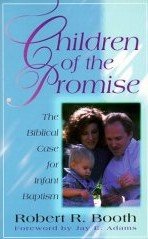
At the end of my first year in seminary, Big Red and his family moved into our apartment complex, which allowed us to continue our theological conversations on a much more regular basis. During one of our talks, I spied a book on Red’s desk called Children of the Promise by Randy Booth. To my shock and horror, the subtitle was The Biblical Case for Infant Baptism. What an oxymoron! I knew that there was absolutely no Biblical evidence for baptizing infants. This was a tradition left over from Rome.

I made no mention of this to Red, but I immediately procured the book from The Master’s library. I read it with extreme skepticism. I doubted every assertion and quibbled over every point of his exegesis, but after reading the book, I knew I was in serious trouble. I was far from convinced, but for the first time, I had to acknowledge that there was a legitimate Biblical argument for infant baptism.

I had always approached baptism as an independent issue. Booth’s book helped me understand that baptism is largely determined by the relationship between Israel and the church. Baptism is a symptom of ecclesiology.

For the next couple of years, I wrestled with the issue of Israel and the church. During this time I read through the Bible multiple times, always with an eye towards understanding the relationship between Israel and the church. I paid careful attention to Genesis 12-17, Romans 9-11, Galatians 3-4, Hebrews 8-10, as well as hundreds of other related passages. I began to come to the conclusion that the church is a continuation of what God began with Abraham (and ultimately with Adam).

When I came to reject a hard distinction between Israel and the church, my dispensational house of cards toppled. However, I did not immediately jump to a covenantal view. I made a pit stop in New Covenant Theology, a Reformed Baptist sect of recent origin.

Tuesday, October 24, 2006

Leaving Dispensationalism Behind (Part Two)

We moved to Los Angeles in July of 1999 to attend The Master’s Seminary. During one of our first Sundays at Grace Community Church, we met a young couple who had just moved to California for a new job. We quickly became friends with Big Red and Mrs. Big Red (despite their aberrant collegiate loyalties). We invited them over for dinner, and during the course of the evening, Big Red began to articulate a partial preterist view of prophecy. I was somewhat familiar with amillennialism, but I had never encountered preterism.

I applied the standard dispensational defense and accused Big Red of “spiritualizing” and “allegorizing.” Unfazed, Big Red urged me to apply my “literalism” to the time texts in the Olivet Discourse and the book of Revelation. I couldn’t. I was dumbfounded. And scared. For the next week, I felt like a zombie. I had just moved my family half-way across the country, and I was wondering if I had made a mistake.

I read the Bible voraciously. Time texts seemed to jump off of every page. I could not avoid them or explain them away. I borrowed Big Red’s copy of The Last Days According to Jesus by R.C. Sproul and read it twice. I listened to a set of tapes from a Ligonier conference on eschatology. I was blown away. My dispensational ship had hit an iceberg and began to take on water.

However, I was starting my first semester of seminary, and so, I tried to put preterism and eschatology on the back burner. Without intending to, I wound up writing a couple of seminary papers refuting aspects of preterism, but I always had an uneasy feeling in the back of my mind. The time texts continued to plague me throughout the year, particularly Matthew 24:34,

“Assuredly, I say to you, this generation will by no means pass away till all these things take place.”

As I wrestled with this text and others, I dug my heels in, stubbornly refusing to admit defeat. I scoured the Bible for answers. Big Red patiently endured my feeble objections. By the end of my first year in seminary, I clearly saw the fatal flaw in dispensational eschatology: selective literalism.

However, it would be another two years before I would embrace preterism. In the meantime, a new problem arose. Big Red began talking about the “B” word, and I was appalled.

Monday, October 09, 2006

Leaving Dispensationalism Behind (Part One)


I was introduced to dispensationalism at the age of twelve by the movie, A Thief in the Night. A couple of years later, I was attending a Christian high school basketball game. They were giving hand stamps so that you could enter and leave the facility, but I refused the stamp, thinking it could be the mark of the beast. I was a teenage dispensationalist.

During spring break in my junior year at college, I took a trip to Daytona beach with Campus Crusade for Christ, and heard Ron Ralston give a week’s worth of lectures on the end times from a staunchly dispensational perspective. He was so persuasive that I immediately jumped on board.

After graduating from college, I read Faith Works by John MacArthur, and was intrigued by the appendix on dispensationalism. I loved MacArthur’s commitment to the Bible, and I was hungry to understand the Biblical basis for dispensationalism.

I read Dispensationalism Today by Charles Ryrie. I appreciated his presentation of the sine qua non of dispensationalism, but overall, I was deeply disappointed by the lack of Biblical exegesis and the reliance upon philosophical arguments.

I tried reading Dispensationalism, Israel, and the Church but understood very little. Blaising and Bock’s second book, Progressive Dispensationalism, was more helpful, but I was still lacking a comprehensive dispensational worldview.

About that time, I started attending a Bible church, where dispensationalism was alive and well. For five years, I was taught classic-dispensationalism, which centered on three main points:

1) Literal Interpretation
2) A Distinction between Israel and the Church
3) Pre-Mill Eschatology with a Pre-Trib Rapture

I fully imbibed from the dispensational tap, first with The Ryrie Study Bible and later with The MacArthur Study Bible. I read The Greatness of the Kingdom by Alva J. McClain, Things to Come by Dwight Pentecost, and other similar books. Most importantly, the pastor was very generous with his time, fielding my questions and patiently explaining the finer points of dispensationalism to me.

The first ripple in my dispensational pond started when a friend of mine began to show me some flaws in the classic-dispensational view of the kingdom, particularly that Israel did not reject Christ’s “offer” of the Millennial Kingdom in his first advent. I re-read the two Blaising and Bock books with a much greater appreciation. I agreed with their critique of classic-dispensationalism, particularly with regard to the present nature of kingdom. This was confirmed as I taught through the Lord’s Prayer.

So, I migrated to a progressive-dispensational understanding of the Bible. No problem, I thought. I’m still a dispensationalist. I still believe in a literal hermeneutic, a distinction between Israel and the Church, and a pre-trib rapture.

However, I hit another speed bump during a Wednesday night series on eschatology, when I was asked to teach on the difference between the rapture and the second coming. As I diligently studied for this, I was alarmed at the paucity of Biblical evidence for such a distinction. I concluded that I must to do a full-scale study of eschatology at some point.

About this time, I decided to attend The Master’s Seminary in Los Angeles, California. I longed for the opportunity to study the Bible in detail and polish my theological views. I had no idea that within a month of moving to LA, my dispensational ship would hit an iceberg and began to take on water.

Welcome!


I started this blog because I hope 1) to assist those who have questions about dispensationalism and 2) to challenge those who are committed to dispensationalism to reconsider the Biblical evidence. I am committed to keeping the tone irenic and charitable. I have no desire to host a SMOG (Slinging Mud On Blog).

I am qualified to provide an even-handed critique, as I was immersed in dispensationalism for ten years. I was part of a dispensational church for five years, and then, I spent five years at The Master’s Seminary, one of the top dispensational schools in the world. I graduated summa cum laude in May 2004 with a Master of Divinity. I am now the pastor of Christ Covenant Presbyterian Church (PCA) in Kansas City, Missouri.

Most of my posts will be in one of these three categories that are unique to dispensationalism:

• Hermeneutics – literal interpretation, metaphor, typology, etc.
• Ecclesiology – Israel, the Church, dispensations, covenants, etc.
• Eschatology – end times, the rapture, pre-trib, pre-mill, etc.

My first few posts will be autobiographical sketches of my journey into and out of dispensationalism. These are not intended to be full-scale critiques with proof texts. That will come later. Pax.